

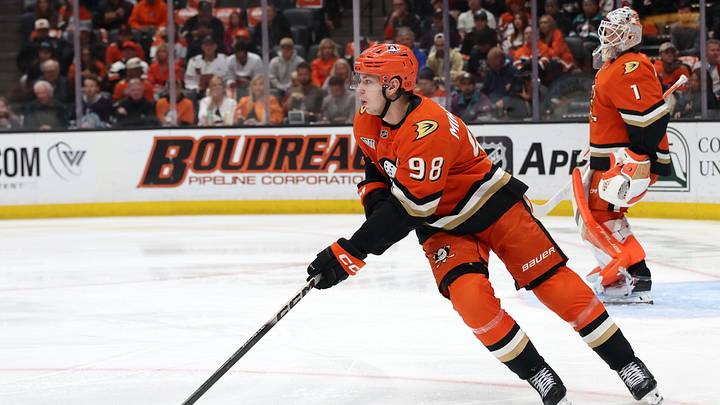
The Anaheim Ducks concluded the 2026 season with a solid and inspiring playoff performance, but now the offseason is in full swing. We already took a look at some potential free agents the Ducks could target, and which veteran forwards would be worth keeping around. One of the more compelling subplots of the summer though, will be how Ducks management navigate their upcoming restricted free agents. Some are major players for the Ducks future, while others are either role players and or have yet to hit their true potential. The Ducks will have six RFA contracts to settle this summer, but who should the Ducks keep and who should they let go?
Defintely keep
Leo Carlsson
This is obviously a no brainer, as Carlsson is not only the number center for the Anaheim Ducks, but a pillar for the future of the franchise. Carlsson took that next step in 2025-26, as he elevated his production to almost a point per game clip with 67 points (29 goals, 38 assists) in 70 games. Carlsson also saw a three-minute increase in his average ice time (19:09) and was regularly used on the Ducks powerplay. His game translated well in the postseason too, as Carlsson notched 11 points (4 goals, 7 assists) in 12 games and helped catapult the Ducks onto the national stage.
THE DUCKS ARE TAKING OVER, LEO CARLSSON PUTS THEM UP TWO 🤯 pic.twitter.com/5UaB81yKPl
— B/R Open Ice (@BR_OpenIce) April 25, 2026
According to AFP Analytics, Carlsson is projected to have either a 3-year extension around 8.2 million per season or an 8-year contract around 11.4 million per season, and honestly, Carlsson might be worth even more than that. Number one centers are tough to come by and a franchise normally has to endure years of suffering before getting lucky enough to draft a center of Carlsson's ability. The only problem could be in the form of Ducks GM Pat Verbeek, as he has a reputation of grinding RFAs. Mason McTavish's RFA negotiations last summer cost him training camp and negotiations with Trevor Zegras the summer before dragged on longer than anticipated, causing a rift with the team. Hopefully, Verbeek does not apply the same strategy with Carlsson, as the center is valuable to the franchise's success.
Cutter Gauthier
Gauthier had his breakout during the regular season, notching 69 points, and becoming the first Ducks skater to eclipse the 40-goal plateau in 15 years. Not bad work for Gauthier who primarily skated on the third line and averaged 17:15 in ice time. Gauthier was also deployed on the powerplay, and he was not afraid to shoot the puck, putting 285 shots on opposing goalies. In the postseason, Gauthier led the Ducks in scoring with 12 points (4 goals, 8 assists) in less ice time (16:15).
🚨 Cutter 🚨
— Anaheim Ducks (@AnaheimDucks) May 1, 2026
We make it three on the power play! #FlyTogether pic.twitter.com/Q6HvE6HWD3
40-goal scores are hard to come by and like Carlsson, Gauthier should be viewed as a future pillar of the franchise. Gauthier's next contract is projected to be either a 3-year extension at 6.3 million per season or a 7-year extension at 8.8 million per season. For comparison, Alex Debrincat of the Red Wings also scored 41 goals and has a cap hit of 7.8 million for next season. Matt Boldy of the Minnesota Wild scored 42 goals and has a cap hit of 7 million per season. While Gauthier's long-term projection seems high, with a rising cap and his necessity to the Ducks success, the 8 million average seems valid. Much like Carlsson, Verbeek would be wise not to drag out Gauthier's extension either.
Should keep
Pavel Mintyukov
After spending the first quarter of the 2025-26 season in the doghouse, Mintyukov became a regular fixture on the Ducks blue line. In 73 games, Mintyukov notched 22 points (8 goals, 14 assists) and averaged 18:26 of ice time. Even though the bulk of his ice time was on the third pairing, once John Carlson came over at the trade deadline, Mintyukov became his regular defense partner and his usage increased. Of all the Ducks defenseman, Mintyukov was second in total of short-handed ice time with 163:38.
MINTY FRESH 🍵
— Victory+ (@victoryplustv) December 30, 2025
Pavel Mintyukov brings the Ducks within one with his fifth goal of the season!
#FlyTogether pic.twitter.com/XyAAFdFFEl
While Mintyukov's offensive production in the postseason was non-existent, as he did not register a point in the Ducks 12 playoff games, he had the fourth most ice time of Ducks defenders with 19:26 per game. With Olen Zellweger being a healthy scratch in the postseason, Ian Moore flipping back and forth from winger to defenseman, and Tyson Hinds just breaking in, Mintyukov is probably the best bet to lock up an extension with the Ducks. Mintyukov is projected for a 2-year extension at 3.4 million per season or a 6-year extension at 6 million per season.
Trade bait
Honestly, outside of Carlsson and Gauthier, Ducks management could trade away any of thier young defenders for an upgrade on offense or a right-handed defenseman that is more in his prime than a Radko Gudas or a John Carlson. Or they could keep all the young defenseman and fill the holes in the lineup from the departing veterans. But if any of these defenseman left, the Ducks should not be concerned with their future development, as long as they get significant help in the process.
Olen Zellweger
Zellweger played in 76 regular season games, had 22 points (7 goals, 15 assists), and averaged 16:59 of ice time. As previously mentioned though, Zellweger was consistently scratched towards the end of the regular season and into the postseason. In his 3 playoff appearances, Zellweger registered a goal and an assist, while averaging just 13:58 of ice time and skating on the third pairing.
Despite the decrease in usage though, Zellweger is projected for either a 2-year extension at 3.2 million per season or a 7-year deal at 6.5 million per season. With how his last couple months with the Ducks ended though, Zellweger is unlikely to sign an extension with Anaheim.
Ian Moore
In 67 regular season games, Moore registered 12 points (4 goals, 8 assists) and averaged 13:40 of ice time. When playing on defense, Moore primarily skated on the third pairing, but when deployed as a forward, he was a fourth line winger. Moore is projected for just a 2-year extension at 1.7 million per season.
Is he a defender or is he a forward? And that's the conumdrum for the Ducks management and coaching staff. Being a right-handed shot, Moore provides at least a different look to the blue line, as the bulk of the young Ducks defenseman are left-handed. But for whatever reason, the Ducks seemed hellbent on shoehorning Moore into the forward group, where he is least impactful. But that kind of skillset, could make him a valuable trade asset.
Tyson Hinds
Although his callup to the Ducks was brief, Hinds at least was able to get some valuable experience. In 6 regular season games, Hinds did not register a point and averaged 15:37 of ice time. In the playoffs, Hinds played in 9 games, registered an assist, and averaged 11:01 of ice time. Though he primarily skated on the third pair, Hinds at least brought a different wrinkle to the Ducks blue line, as he is a more traditional shutdown defender, instead of joining the rush like other Ducks defensemen to create offense.
Hinds is projected for just a 1-year deal at $850,000. The raw talent is there, and you can Hinds blossoming into a shutdown force opposite of Jackson LaCombe. But the Ducks are already swamped with left-handed defenseman and Hinds is another on that list. The Ducks could trade Hinds as part of a package and his cap hit would be negligible in a potential deal.
 Add us as a preferred source on Google