

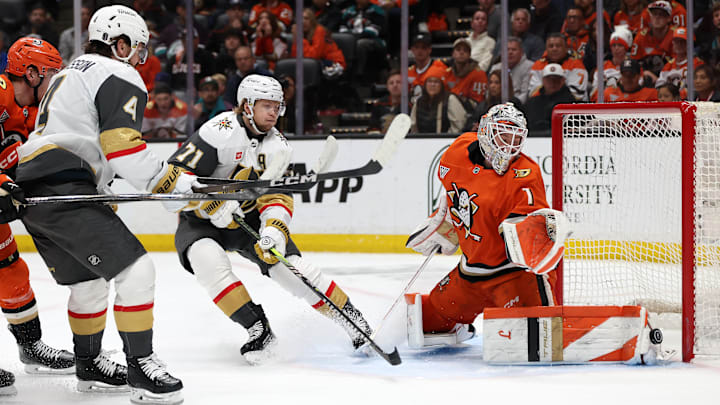
While there were plenty of highs from the Anaheim Ducks 2026 postseason run, there were plenty of lows too. And when the Ducks desperately needed a win in Game 6 of the second round against Vegas, their playoff run ended with a collective thud, as they got waxed by a final score of 5-1 at Honda Center. As frustrating and disheartening as the end result may have been, the final game from the Ducks was a mixture of a season's long laundry list of flaws, coming to a head at the most inopportune time.
First goals on first shots
A trend that began in the regular season, where Lukas Dostal had a bad habit of surrendering the first goal of a game on just the first shot. This happened 11 times in the regular season and 3 times in the postseason, with the last occurrence being in the penultimate Game 6.
wanna see some magic? 🫢 pic.twitter.com/uA5Lip0D3e
— Vegas Golden Knights (@GoldenKnights) May 15, 2026
Full marks to Mitch Marner for making an incredible play, but in a decisive game, that goal cannot happen so soon. Jacob Trouba and Jackson LaCombe should take some of the blame as well, for allowing that stretch pass to get behind the pair but being down early was a common theme and a mountain the Ducks could not ultimately overcome.
Bad goaltending
Much in line with the first flaw, Dostal was not great in the 2026 postseason, as he finished with an .870 save percentage and 3.54 goals against average. While there were moments in which the vintage Vezina-like Dostal appeared, such as Game 5 against Vegas and Game 4 against Edmonton, Dostal was also pulled twice in the postseason. The real backbreakers though, were the simple and easy saves that somehow squeaked through and just compounded Dostal's inability to get in a rhythm.
PAVEL.
— Vegas Golden Knights (@GoldenKnights) May 15, 2026
SCORE.
O.
FEYEV. pic.twitter.com/fgeKJuD6L8
The veterans disappeared
Outside of Mikael Granlund (4 points) and Alex Killorn (3 points), the Ducks veterans were either almost invisible or ineffective in the second round. Chris Kreider had 2 points (1 goal and 1 assist), but should have had more of an impact, as he was maddeningly deployed on the top line with Leo Carlsson and Troy Terry. Even worse, he was careless with puck and made mistakes that even the Ducks rookies wouldn't.
DOROFEYEV STEALS IT AND DOROFEYEV RIPS IT 🎯
— Gino Hard (@GinoHard_) May 13, 2026
WE'RE TIED AT 1 IN VEGAS 🚨 pic.twitter.com/sy9uQ98MZd
And it wasn't just Kreider either. Jacob Trouba was prone to the boneheaded clear attempt or favoring the big hit over making a simple play. Trouba was arguably deployed higher in the Ducks lineup than he should have been, and the results speak for themselves, as he finished the second round without even registering a point, despite averaging 23:37 of ice time. John Carlson was brought in at the trade deadline to boost the Ducks offense and powerplay, but he just had a single assist in the second round, while averaging 23:36 of ice time. Radko Gudas never saw the ice in the second round, though that was due to an injury he sustained earlier in the playoffs against Edmonton.
Poor special teams
There was a clear night and day difference between Anaheim's special teams in the opening round against Edmonton versus in the second round against Vegas. The Ducks were able to capitalize on the porous defense and leaky goaltending of the Oilers, to a tune of a 50 percent conversion rate on the powerplay, which led the NHL after round one, and a 71.4 penalty kill rate combined with scoring a shorthanded goal.
Against a more structured team like the Golden Knights, the Ducks struggled mightily with special teams. Their powerplay cratered, to a 9.1 percent conversion rate, 4 goals on 22 opportunities. Baked into that equation, is the fact the Ducks allowed two shorthanded goals against in the series, with the last instance occurring in the pivotal Game 6.
BRETT HOWDEN, ARE YOU KIDDING????? 🫨 pic.twitter.com/miO4rOVJKa
— Vegas Golden Knights (@GoldenKnights) May 15, 2026
The penalty kill was just as meager at 66.7 percent, giving up 5 Vegas powerplay goals on 15 opportunities. The Ducks rarely threatened to score while shorthanded and once Ryan Poehling was knocked out of the series, who was tied for the team lead in shorthanded goals during the regular season, their ability to offset the Vegas powerplay diminished.
Final thoughts
The Ducks were an imperfect team that made a surprise run in the 2026 playoffs. While they were able to succeed in the opening round against a similarly imperfect opponent, Vegas' veterans and defensively superior style of postseason play laid the Ducks flaws out to bare in the second round. With offseason now upon the Ducks though, the team has time to reflect and make adjustments to what was successful and what needs to be changed.
 Add us as a preferred source on Google